Wednesday, October 13, 2010

Project Tic Toc


image


Two American scientists are lost in the swirling maze of past and future ages, during the first experiments on America's greatest and most secret project, the Time Tunnel. Tony Newman and Doug Phillips now tumble helplessly toward a new fantastic adventure, somewhere along the infinite corridors of time. – Opening voice over credits


During the mid-1960s science fiction returned to network television in a big way.


While the 1950’s had seen shows such as One Step BeyondThe Twilight Zone, and even earlier efforts like Tales of Tomorrow – very few of their episodes provided anything in the way of special effects or `hard science’ fiction.


That is, until Irwin Allen brought Voyage to the Bottom of The Sea to TV.  And it’s first year – 1964-65 – produced a well-remembered block of solid episodes with both sci-fi and cold war elements. 


The network (ABC) apparently decided the show was too `dark’, and for its second season (filmed in color), pushed for more of the `monster of the week’ type episodes.  


As the series progressed, things just got sillier.


In 1966, Irwin Allen would launch two other sci-fi series; Lost in Space  and The Time Tunnel.


1966 will also be remembered for the launch of the most durable sci-fi franchise of them all . . .  Star Trek.


While popular with the younger generation, none of these 3 shows would make the top 30 in the Nielson ratings that year.


Lost in Space, which began with promise - like Voyage to the Bottom of the Sea - descended into juvenile antics and `camp’. By its second season, every 12 year-old I knew had decided it was a `kids’ show, and had migrated to Star Trek.


The Time Tunnel, however, was for the most part more of an `adult’ series (although it too had its low moments).


The stars were Robert Colbert and James Darren, both popular actors in the 1960s.


Colbert had reluctantly played `Brent Maverick’ in two episodes of the long running western series, but was mercifully not called back for the final season.  He also showed up in popular series like The Virginian, 77 Sunset Strip, 12 0’Clock High, Perry Mason, and Bonanza.


Darren started out as a teen idol, appearing as Moondoggie in several Gidget films, and had a successful recording career.  His biggest selling record – which is still played 50 years later – was Goodbye Cruel World.


Darren also appeared in 1961’s The Guns of Navarone, but it was The Time Tunnel that really helped him shed his teen idol image.


Venerable character actor Whit Bissell, and  the winner of the 1955 Miss America pageant – Lee Meriwether – rounded out the cast.


The plot was simple (and would be reused by Voyagers! and to an extent, by Quantum Leap).  Our two heroes would `jump’ into a new time (always at an important moment) and have to try to change history.


Each episode would end with one of Irwin Allen’s patented cliff hangers, as Tony & Doug landed in a new predicament.


Using stock footage from the vast 20th Century Fox library of historical dramas, and selective `editing in’ of the central characters, the show had a `bigger budget’ feel than most TV shows of the day.


Despite that advantage, the pilot episode cost an astounding $500,000 and was the most expensive hour produced to that point.


The series lasted but one season.  While the ratings weren’t terrible, the story goes that studio executives wanted to promote The Legend of Custer, but there was no open slot in the schedule.


Something had to go.

Given the costs of production, the decision was to cut the Time Tunnel loose.   Custer was panned by critics and viewers alike, and went down in flames after just one season.


FANCAST has all 30 episodes of The Time Tunnel available for you to view online.  

You can access them at this link.


The cast would move on successfully to other projects, with James Darren becoming a regular on T.J. Hooker and later making appearances on Star Trek: Deep Space Nine.


Colbert would spend a decade on the daytime soap The Young and the Restless, and later appear on Baywatch.


Both actors remained active into the 1990s.


Lee Meriwether worked steadily, including such famous roles as Catwoman on Batman (1966), she replaced Barbara Bain on Mission Impossible for 6 episodes during its 4th season, and spent 7 years helping Buddy Ebsen solve crimes on Barnaby Jones.


Whit Bissell passed away in 1996, with nearly 300 credits listed on the Internet Movie Database.


Tuesday, October 5, 2010

October-Drive-In-Horror-Movie-Fest


image

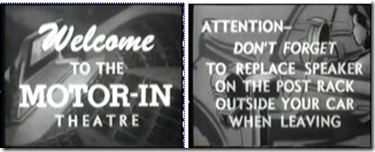
Sign generator link.  Try it. Very neat.

Not only is October the month for ghosts and ghouls and things that go bump in the night, it was one of the best months of the year to enjoy drive-in movies as I grew up here in Florida.


The mosquitoes were mostly gone, as were the early evening thunderstorms (windshield wipers were always an annoyance at the drive-in), and the temperatures were just right.


Showtime was always just past sundown, so the first few minutes of the film was often washed out a bit by the twilight, but the experience was pure 1950’s and 1960’s Americana.  


Consuming bad movies (usually a double feature), along with heart-attack provoking food, from the comfort of our land yachts.

An experience that today’s high-tech multiplex cinema's simply can’t match.


To get us started, first a sampling of some of the old intermission and coming attraction reels . . .  then a pair of horrible double features, complete with a cartoon.

image

Drive-in intermission 

Drive-in Intermission 2

Drive-in Intermission 5

Drive In Intermission 7

Drive-in Intermission 9

image

If the intermissions listed above aren’t enough, you can view the entire list available from the Internet Archive  at this link.


Although drive-ins certainly showed first-run `A’ movies (I saw How The West Was Won and Star Wars at a drive-in), their real claim to fame were those cheaply made sub-B movies that were so bad, they only aired on the late-late-late show on television years later.


But that was half the fun.


You didn’t have to pay attention to the plot (there usually wasn’t one), and if you fell asleep (passed out, went to the restroom, etc.) you could easily pick up from when you regained awareness of your surroundings.


Today a double double-feature.


First, a pair of low budget cheesy sexploitative movies of the early 1950s that some kind soul on the Internet Archive has stitched together into a double feature, complete with cartoon.

drivein

Call them guilty pleasures, or research into the peculiar mores of our parent’s generation.  Just don’t expect them to be anything more than horrible old movies  . . .  the kind we used to watch at the drive in.

image 


Shocker Internet Drive In Week 1


Of course, for hardcore horror fans, these first two movies are a bit tame, and for you we’ve got the granddaddy of them all – George Romero’s Night of the Living Dead and the 1960s classic Carnival of Souls  again served up as a drive-in Double Feature.

image

Shocker Internet Drive In Week 4 - Night of the Living Dead Double Feature


So pop some popcorn, grill up some hamburgers, and remove your window screens to let in a few mosquitoes . . .


And enjoy the show!


Friday, September 24, 2010

A Classical Act


My brother, the internationally infamous banjo player, is fond of saying that he has studied all the masters of classical music.


“Beethoven,  Mozart . . .  umm . . .  Gucci  . . .  Rimsky-Korsakov . . .  umm. . .  Black & Decker, Briggs and Stratton . . . all the greats.”


Of course, some people prefer their classical music played by a full orchestra, instead of on a banjo.


Go figure.


Since there’s no accounting for taste . . . and I do try to be inclusive in this blog  . . .  today I’ve a repository of  classical music freely available for you to download for your own listening pleasure.


I’m currently downloading my favorite symphony, Rimsky-Korsakov’s  Scheherazade which I plan to save to my beloved iPod Touch.


But that just scratches the surface of this collection, made available by the Peabody Institute at Johns Hopkins University.


I’ll let their Website describe the offerings.


image

 
Peabody Orchestras

The orchestral division of the Peabody Conservatory is comprised of two full symphonic orchestras.

The Peabody Symphony Orchestra draws its members primarily from graduate and upper-division students of the highest level of musicianship, and performs six to seven public concert programs each season.

The Peabody Concert Orchestra, whose members are drawn mainly from undergraduate students, performs six public concert programs per season.


The individual recordings are simply too numerous to list, but for 6 full seasons of the PSO (Peabody Symphony Orchestra) recordings, follow this link.


And for six seasons of the PCO (Peabody Concert Orchestra) efforts, follow this link.


These are live concert recordings, not pristine studio sessions.  But they are of high quality, well performed, and would make the basis for a fine collection of classical music.


Whether your interests run to Tchaikovsky’s Nut Cracker, or to Stravinsky's Firebird, or Handel’s Messiah   . . .  I’m sure you’ll find a lot here to download and enjoy.

Another Lucky Strike Extra


Two years ago, when I began this blog, my second entry was called 'Twas Rock & Roll That Killed Your Hit Parade, which looked back at the Lucky Strike Hit Parade show of the early 1950's.


Shortly thereafter I received a very kind email from Andrew Lee Fielding, whose mother Sue Bennett was one of the early stars of television, and a regular on Your Hit Parade.


We exchanged several emails, and Andrew told me about a book he had written about his mother's career and early television. He was nice enough to send me a copy.


I wrote a full review of The Lucky Strike Papers in And Now, A Lucky Strike Extra . . .


Andrew also has his own blog, which you’ll find linked on my sidebar.


About once a year I mention this highly entertaining and informative book since I believe it would make a worthy addition to anyone's library.


Especially since I figure some of my newer readers may not have read the original review buried 150 blogs in the past.


With the Holidays upcoming, this would be a terrific gift for anyone with a love of nostalgia.

Saturday, September 18, 2010

An Evening With George Burns


 image


A couple of years ago I invited my readers to Spend `An Evening With Groucho Marx', a little over an hour of songs and reminiscences which was recorded in 1972 when Groucho was 81 years of age.


Today, in that same tradition, we’ve the legendary George Burns in 1974 - at the age of 78 - doing a one man show at the Shubert Theater.


There’s an affectionate introduction by his best friend Jack Benny, but after that, it’s just pretty much just George and his musical accompaniment  (and briefly guest pianist/composer Randy Newman).


Jack Benny, sadly, would die later that year from pancreatic cancer.


George, at an age when most entertainers are thinking about retirement, was on the verge of huge resurgence in popularity and his greatest show business success.


In 1975, just a year after this performance,  Burns won an Academy Award for best supporting actor in The Sunshine Boys.  He replaced an ailing Jack Benny, who was originally slated for the role.


He would follow that success up in 1977 with the hugely popular `Oh God!’  followed by eight more movies over the next 20 years.


But all of that success still lay before George when this show was taped.  Here he tells stories of his life and career with Gracie in Vaudeville, sings obscure songs, and tells funny stories about his show business friends.


A more complete history of George Burns and Gracie Allen will wait for a later blog when I’ll feature their TV and radio careers.


For now, simply enjoy An Evening With George Burns.


Tennessee Bill’s OTR has his one-man performance available as either a single file  or in 19 short chapters.

Index of /otr/Evening With George Burns


There are a few blips in the audio recording, but the show is well worth listening to.