Sunday, September 13, 2009

My Man (Arthur) Godfrey


image


During the 1950s there was probably no Television (or radio, for that matter) personality more immediately recognizable to the American audience than Arthur Morton Leo Godfrey (August 31, 1903 – March 16, 1983). 


His red hair (ok, it was black & white TV, but they mentioned it a lot), and ukulele were trademarks, as was his folksy delivery and common man demeanor.   He was a TV host, a talent scout, a radio personality, and a pitchman for numerous advertisers.


If he liked you, and you had talent, he could make you a star.  But of course, if he didn’t like you . . . .

But before he became arguably the king of 1950’s television (he had 2 weekly shows, and a daily 90-minute morning show at one point), Godfrey got his start in radio in the 1930s.


While still working for a regional radio station in 1933, Godfrey was involved in an auto accident and spent months in the hospital. His only entertainment was the beside radio, and he listened for hours.  It was then he realized that the stiff, formal speech patterns of most on-air personalities didn’t `connect’ with the listener.


He vowed to develop a folksy style – like he was talking to just one person – if he ever returned to the airwaves.  Which he did on a local radio show in the Washington D.C. market.  


By 1942 he had managed to become the announcer for  Fred Allen's Texaco Star Theater show on CBS radio, but left after a dispute with the star after just 6 weeks.


Godfrey reached the nation’s attention while describing the funeral procession of President Roosevelt in 1945. His folksy, common man narrative was picked up by the networks, and broadcast around the country. 


Choking back tears, Godfrey intoned "God bless him, President Truman” when the newly inaugurated president passed by.


CBS was so impressed with him, they gave him a nationally syndicated morning show Arthur Godfrey Time on the radio.  Two years later (1947), Godfrey struck gold again with a novelty tune “The Too Fat Polka”.


After that, CBS gave him a primetime variety show, Arthur Godfrey's Talent Scouts.  A variation of the popular Amateur Hour, Talent Scouts saw a number of famous entertainers break into show business.


Wally Cox and the Chordettes both appeared on the same show, and Godfrey signed the Chordettes to be part of his radio and (eventually) television family.


While Godfrey’s show highlighted early appearances by the likes of Roy Clark, Lenny Bruce, Don Adams, Tony Bennett, Patsy Cline, and Pat Boone he also rejected a very young Elvis Presley and Sonny Till & The Orioles.


CBS was in danger of becoming the All Godfrey All The Time Network by the mid 1950s, with the ubiquitous Godfrey showing up five mornings and a couple of nights each week on the schedule.


His abilities as a pitchman for products (Lipton Tea and Soup, Frigidaire, and Chesterfield Cigarettes among others) was legendary.  He would wander from the script, poke gentle fun at the sponsors (but never the product), much to the delight of audiences.


Sponsors, if they were unnerved by his antics, quickly learned that their sales went up when Godfrey pitched them.


Godfrey was an amateur radio operator (Ham), and an accomplished private pilot, and would often talk about his hobbies and interests on the air.


But there was a dark side to Godfrey as well, one that began to bubble to the surface publicly during the 1950s.  Some people place the blame on the pain he endured after his auto accident two decades earlier, and the subsequent operations he underwent.


Godfrey was eager to groom new talent, but was a tough taskmaster.  He insisted that his `little Godfreys’, members of his cast, take ongoing dancing and singing lessons, and maintained tight control over their careers.


One member of his cast was Julius LaRosa, who was a popular vocalist on the show.  He chafed at having to take the dance lessons, and missed one due to a family emergency.   Godfrey punished him by  barring him from the show for a day.


LaRosa hired an agent to renegotiate his contract, and was blindsided when – during a broadcast – Godfrey announced that LaRosa was leaving the show.


After LaRosa told the press he had no idea he was going to be fired, Godfrey called his own press conference, and said that LaRosa had lost his `humility’.  


The public slowly began to suspect that it was Godfrey, not LaRosa, who lacked humility.


The firings continued, with Godfrey’s bandleader, and the Chordettes next to go (replaced by the McGuire Sisters), and the controversies grew.  Comedians openly mocked Godfrey, and his image suffered (I’ve an example below).


Two movies were made about `Godfrey-like’ media personalities, and neither were flattering.  The Great Man (1956) starring Jose Ferrer, and Elia Kazan's classic A Face in the Crowd (1957) starring a very young Andy Griffith.


Although his star was tarnished by the controversies, Godfrey continued to appear regularly on TV until 1959, when his doctors discovered he had lung cancer.  Remarkably, Godfrey beat the odds, and lived another 24 years after surgical removal of one of his lungs. 


Flawed or not, Godfrey was genuinely one of the pioneers of early TV and radio, and we are lucky enough to have some of his later radio shows (recalling the 1950’s), and some kinescopes of his shows of the 1950s.  


All are available on The Internet Archive.


First, some reminiscing by Godfrey in 1972 about his broadcast career and broadcasting in general during the 1950’s.


Recalling 1956         6.80 MB

Recalling 1955         6.90 MB

Recalling 1954         6.86 MB

Recalling 1953         6.91 MB

Recalling 1952         7.11 MB

Recalling 1951         6.90 MB

Recalling 1950         6.87 MB

Recalling 1949         6.89 MB


image

Arthur Godfrey's Talent Scouts (1956)
Episode of "Arthur Godfrey's Talent Scouts" from July 30, 1956.


"Arthur Godfrey and his friends" - 28/January/1953
Partial program of "Arthur Godfrey and his friends": Marion Marlowe, Julius LaRosa, The McGuire Sisters and Frank Parker from January 28th, 1953.

image


These next two videos are part of a documentary/commercial created for Eastern Airlines by Godfrey, extolling the virtues of modern air travel.   Interesting from a historical perspective, and for all aviation buffs as well.


Flying with Arthur Godfrey (Part I) - Fairbanks (Jerry) Productions
TV host Arthur Godfrey takes controls of a passenger plane to demonstrate airline operations.

Flying with Arthur Godfrey (Part II) - Fairbanks (Jerry) Productions
TV host Arthur Godfrey takes controls of a passenger plane to demonstrate airline operations.

image


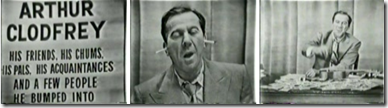
And a parody (and probably not intended kindly) by Jerry Lester, host of The Cavalcade of Stars, of Arthur Godfrey.  


It is mercifully short.


"Cavalcade of Stars": Arthur Clodfrey
Clip from the 50's TV series "Cavalcade of Stars" featuring a parody of Arthur Godfrey called "Arthur Clodfrey Time". Features parodies of early commercials and plugs, and the unpredictable nature of live TV. Certainly historically important, But you really have to know about early commercials to find this funny, Otherwise you will be confused
 image


Godfrey returned to his morning radio show in the 1960s, and would continue on with it for another decade, but his TV appearances dwindled. 


He had some guest shots in a handful of movies, co-hosted Candid Camera briefly with Allan Funt (another professional relationship that reportedly ended badly), and made commercials – but his heyday was through.


Godfrey died in 1983 of Emphysema, at the age of 80.

Friday, September 4, 2009

Cummings Attractions


image


Television sitcoms have come a long way since the early days of television.   


Of course, that isn’t necessarily a complement.


Fifty years ago, one of the best sitcoms was The Bob Cummings show, aka Love That Bob (in syndication).   It began in 1955 on CBS, moved to NBC after half a season where it ran for two years, then returned to CBS for its final two year run.  


It was syndicated during daytimes in the 1960s as Love That Bob on ABC.


The plot was pretty simple.  Bob Cummings played Bob Collins, a Hollywood photographer, ladies man, and air force reservist.  He is constantly pursuing the the gorgeous models he photographs, but his plans more often than not fall apart.


This series, which co-starred Rosemary DeCamp – who is well remembered as playing Jimmy Cagney’s sister in Yankee Doodle Dandy – and also played the part of Peg Riley in the first incarnation of The Life of Riley on TV (with Jackie Gleason).


Ann B. Davis had third billing, but she became hugely popular as `Schultzy’, and had a good deal of screen time in the series. While she went on to play Alice in The Brady Bunch, to my generation she will always be Schultzy. She won two Emmy awards for the role.


The series also starred such up and coming stars as a young Dwayne Hickman (Before he would become Dobie GIllis) and Nancy Culp playing a man-crazy bird watcher before she became Miss Hathaway on The Beverly Hillbillies (Playing almost the same role).

The star was Charles Clarence Robert Orville `Bob’ Cummings (June 9, 1910 – December 2, 1990) – who had matinee idol looks, and a suave delivery – but never quite jelled as a major movie star.


Cummings began working on Broadway in the early 1930s, opposite Fanny Brice.  He’d spent time in England and had perfected an upperclass English accent, which helped his career.    He acted under the name Bruce Hutchens for awhile in the 1930s, but returned to his given name by the late 1930s.


His film career picked up in 1939, when he starred in Three Smart Girls with Deanna Durbin, and then followed that film with a series of fairly lightweight comedies. 


Cummings received good notices for his dramatic performances in Kings Row (1942) , Saboteur (1942), and Dial M for Murder (1954), but his film career languished.  


His films weren’t bad – just largely forgettable.


  • Princess O'Rourke (1943)
  • Flesh and Fantasy (1943)
  • You Came Along (1945)
  • The Bride Wore Boots (1946)
  • The Chase (1946)
  • Heaven Only Knows (1947)
  • The Lost Moment (1947)
  • Sleep, My Love (1948)
  • Let's Live a Little (1948)
  • The Accused (1949)
  • Reign of Terror (1949)
  • Tell It to the Judge (1949)
  • Free for All (1949)
  • Paid in Full (1950)
  • The Petty Girl (1950)
  • For Heaven's Sake (1950)
  • The Barefoot Mailman (1951)
  •  

    But it wasn’t until The Bob Cummings Show that he really gained stardom.  


    He followed up his success with 2 more series attempts (The New Bob Cummings Show, and My Living Doll).  Neither proved to be successful, and both only ran a short time.


    His big show was re-run for about a decade on daytime television, but black & white episodes fell out of fashion by the early 1970s, and since then they’ve seen only limited play.  The copyright on these shows was never renewed, and they have fallen into the public domain.


    While a slower pace than today’s snappy sitcoms, and less risqué (although not altogether innocent), these shows remain an enjoyable window into the humor and lifestyles of 1950s. 


    Here then are 20 episodes from The Internet Archive.


    Love That Bob : Bob Goes Bird Watching
    Bob Retrenches
    Bob Saves Harvey
    Bob's Forgotten Fiancee
    Bob In Orbit
    Bob Plays Margaret's Game
    Bob and Schultzy Reunite
    Bob and the Dumb Blonde
    Bob Gets Harvey A Raise
    Bob and the Ravishing Realtor
    Bob Becomes A Stage Uncle
    Bob DIgs Rock And Roll
    Bob Goes To The Moon
    Bob Judges A Beauty Contest
    Bob Butters Beck, Beck Butters Better
    Grandpa's Christmas Visit
    Grandpa's Old Buddy
    Collins The Crooner
    Grandpa Attends A Convention
    Grandpa Moves West

    Monday, August 31, 2009

    A Lucky Strike Discount


    Back in September of last year, when I began this blog, my second entry was called 'Twas Rock & Roll That Killed Your Hit Parade, which looked back at the Lucky Strike Hit Parade show of the early 1950's.


    Shortly thereafter I received a very kind email from Andrew Lee Fielding, whose mother Sue Bennett was one of the early stars of television, and a regular on Your Hit Parade.


    We exchanged several emails, and Andrew told me about a book he had written about his mother's career and early television. He was nice enough to send me a copy.


    I wrote a full review of The Lucky Strike Papers in And Now, A Lucky Strike Extra . . .


    Andrew also has his own blog, which you’ll find linked on my sidebar.


    This highly entertaining and informative book would make a worthy addition to anyone's library, and with the Holidays upcoming, would be a terrific gift for anyone with a love of nostalgia.


    I bring this up today because Andrew is running a special price on the book, for a limited time.


    If you are interested, I’d hurry up and order. I’ve no idea how long this special will last.

    Saturday, August 29, 2009

    Hollywood Palace 1965


    image


    Variety shows, more than any other medium, show us where our heads, and our hearts were at over the first two decades of TV. In the early 1950’s, many of the shows were largely extensions of Vaudeville or Burlesque, filled with acrobats, baggy pants comedians, and `specialty’ numbers. 


    The budgets were miniscule, the production values nil (unless you count the stage curtain), and the novelty of actually watching TV was so great, that it really didn’t matter what you were watching a lot of the time.  


    There were exceptions, of course.  


    Ed Sullivan’s Toast of the Town, and Dumont’s Cavalcade of Stars, Your Show of Shows, The Colgate Comedy Hour, and others often put on extraordinary shows for the times. 


    By the mid 1950s, once Television had proved it could sell advertising and turn a profit, budgets increased and Variety Shows became big budget extravaganzas with lots of big name guest stars.


    ABC Television was the 3rd network, lacking in affiliates, prestige, and ratings throughout much of the 1950s and 1960s.  They viewed the powerhouse variety shows like CBS’s Ed Sullivan and Red Skelton shows, and NBC’s Bob Hope and Andy Williams shows with more than a little envy, and wanted a `big’ variety show of their own. 


    In January of 1964, after the Jerry Lewis Show failed to gel in the fall of 1963, they turned to Bing Crosby to produce an all star variety show for Saturday nights.   While never the powerhouse that Ed Sullivan created for CBS, The Hollywood Palace proved to be durable enough to run for 7 years.


    Having the highly rated Lawrence Welk Show as a lead-in, no doubt helped, but that also meant that The Hollywood Place played to an older audience than many other shows. 


    They routinely lost out in the ratings to shows like NBC’s Saturday Night At The MoviesGunsmoke, and Mission Impossible. In 1967, the show was moved to Tuesday nights where they got beat by NBC’s Tuesday Night at The Movies.  


    In 1968, they returned to Saturday nights.


    Unlike most variety shows, The Hollywood Palace used `guest’ hosts, although Bing Crosby hosted at total of 31 times (including all of the Christmas Specials).    While never a ratings powerhouse (never in the top 20), the show was a solid if not spectacular variety show.


    Today we’ve 5 shows from 1965.   The video quality on these aren’t the best in the world, but the nostalgia factor and entertainment value remain superb. 


    These shows are on the Internet Archive, and are presumed to be public domain . . . but I’d get them while you can.  Variety shows have a bad habit of being contested regarding their pubic domain status.


    Hollywood Palace - February 6, 1965


    image

    David Janssen as host (formerly Richard Diamond, and now Dr. Richard Kimble of The Fugitive) with --Carl Reiner and Mel Brooks, Edie Adams singing "Love," "I'm Glad There Is You" and "The Man That Got Away", Tim Conway, Vic Damone singing "But Not for Me," "Fascinatin' Rhythm" and "They Can't Take That Away from Me", and the Harlem Globetrotters do basketball tricks. Add in a knife throwing act and a Trapeze act, and you have pretty full hour of entertainment.


    Hollywood Palace - March 27, 1965

    image

    Hosted by Tony Randall and featuring Diana Ross and the Supremes. --Allan Sherman sings "Crazy Downtown" (parody of Petula Clark's "Downtown") --Nelson Eddy and Gale Sherwood sing duets,--Vikki Carr sings  "The Good Life," "So in Love" and "The Days of Wine and Roses" . Throw in Pat Morita, some acrobats, a high wire act, and a wrestling bear . . .   and well, that’s variety for you!


    Hollywood Palace - April 10, 1965


    image

    Host Groucho Marx invites long time comedic foil Margaret Dumont (her last TV appearance)to reprise their classic "Captain Spaulding,"  number from "Animal Crackers."  Groucho’s Daughter (who tried to have a pop singing career) --Melinda Marx sing a `girl group’ number then does a duet with Groucho. Gordon and Sheila MacRae sing and do impressions.  Add to this Shecky Greene, Miriam Makeba, a flamenco dancer, a Scottish comedian, and trick unicyclists from Denmark. 


    Hollywood Palace - October 2, 1965

    image

    Fall of 1965 brought COLOR to much of ABC’s lineup.


    Host Fred Astaire sings and dances, musical guest  We Five do "You Were on My Mind" – Jazz organist Jimmy Smith does "The Organ Grinder's Swing"  --Astaire dances some more -- Jackie Mason does stand-up.--Rudolf Nureyev and Dame Margot Fonteyn do a ballet pas de deux and Paul Lynde & Carmen Phillips  appear in a comedy sketch.


    Hollywood Palace - November 13, 1965

    image 

    Hosted by Judy Garland who sings "Once in a While," I Loved Him" and "We're a Couple of Swells" and a medley of other numbers.  Then is joined by Vic Damone to sing a West Side Story Medley.Chita Rivera dances, the comedy of Jack Burns and Avery Schreiber, and throw in some acrobats and musical clowns for good measure.

    Sunday, August 23, 2009

    There Is Nothing Wrong With Your Television Set . . .


    image


    Do not attempt to adjust the picture. We are controlling transmission. If we wish to make it louder, we will bring up the volume. If we wish to make it softer, we will tune it to a whisper. We will control the horizontal. We will control the vertical. We can roll the image, make it flutter. We can change the focus to a soft blur or sharpen it to crystal clarity. For the next hour, sit quietly and we will control all that you see and hear. We repeat: there is nothing wrong with your television set. You are about to participate in a great adventure. You are about to experience the awe and mystery which reaches from the inner mind to... The Outer Limits.


    — Opening narration  – The Control Voice


    For those of us who grew up huddled around black & white TV sets and could get an ABC affiliate in 1963, these words remind us of one of the great, early science fiction shows of television.  


    Although not a commercial success at the time (only 49 episodes over 1 1/2 seasons was produced), it is now widely regarded as having been ahead of its time.  


    Following in the footsteps of The Twilight Zone, and to a lesser extent Science Fiction Theatre, The Outer Limits presented a darker view of the future, and the dangers of technology. 


    Interestingly, some of the special effects that were used on this seminal series ended up on Star Trek a few years later.  The `transporter effect’ was first used to represent an `ion storm’ in an episode called The Mutant.


    And just like Star Trek, it’s first pilot episode, was turned down by the network.


    You’ll also find a number of actors who would either guest, or even star, on Star Trek in these shows.  James Doohan and Grace Lee Whitney appear in two of the episodes below, but William Shatner and Leonard Nimoy both starred in episodes as well.


    The Outer Limits was an hour long anthology series.  There were no continuing characters, no ongoing story line.  Each story took place in its own `universe’.   


    YOUTUBE has a small selection of episodes in the Classic TV section.  Hopefully they will add to this collection, but for now we have 5 1-hour episodes for your viewing pleasure.  


    There is a short commercial to endure before each show begins.  A small price to pay for a return to . . . The Outer Limits.


    image


    1006 The Outer Limits: The Man Who Was Nev... (51:21)

    (V) Martin Landau portrays a time-traveller desperately trying to stop the birth of an inventor whose bacterium turns humans into mutants.


    1008 The Human Factor (51:30)

    (V) On a military base, in the frozen vastness of Greenland, an army psychiatrist devises a machine which enables him to tune in directly to his patients' thoughts.  

    You’ll find a lot of familiar faces in this one including Gary Merill, Harry Guardino, Sally Kellerman, and Ivan Dixon. 


    1016 Controlled Experiment (51:28)

    (V) The inhabitants of Mars and its satellites, worried by the fact that Earth's warlike humans might spread their ways to other planets, send two messengers to research the peculiar phenomenon known only to the human race -- murder.


    Look for Carroll O’Conner, Grace Lee Whitney, and Barry Morse in this episode.


    1036 The Expanding Human (51:18)

    (V) Roy Clinton, a university professor experiments with a drug that expands human consciousness. 

    Starring Skip Homeier, James Doohan, and Keith Andes.


    1048 The Premonition (51:14)

    (V) Under instruction from flight control director Baldwin, test pilot Jim Darcy executes a maneuver which causes his supersonic plan to exceed heretofore known velocities.


    My thanks to a reader who pointed out that HULU also has episodes from the original (and revived during the 1990s) version of The Outer Limits.    These show may only be available inside the US.


    You’ll find 32 episodes from the original series here.