Monday, June 29, 2009

Shout Hallelujah


image


It is hard to believe that it’s been 4 decades since we lost Judy Garland.   I was scarcely a teenager when she died, but I remember the sadness I felt. 


I grew up in a family that didn’t just appreciate the music, and entertainers, of the 1930s, 1940s, and 1950s . . . we practically revered them.

And Judy Garland had a justifiably high standing in our household.   I grew up on her musicals. 


Not just the Wizard of Oz, but the backyard musicals of Mickey Rooney and Judy Garland, the big MGM productions of the 1940s like  Meet Me In St. Louis, and The Harvey Girls, and The Pirate.   


By the late 1940's, however, Judy’s career was coming unraveled.  She was released from MGM after `a nervous breakdown’ followed by a suicide attempt and having to drop out of a succession of movies including Annie Get Your Gun and The Barkleys of Broadway


Judy Garland, once the box office sensation of MGM, was no longer considered a `good risk’ for the studio.   She would come back, of course.   Her career would rebound after appearances on the London Stage.


In 1954, Garland filmed a remake of A Star Is Born, with James Mason.  While not a commercial success for Warner Brothers, it was a triumphant return for Judy.  She was nominated for an Academy Award, but lost to Grace Kelly that year.


During the late 1950s and much of the 1960s, Judy made concert appearances (including Judy at Carnegie Hall in 1961), and appeared in television specials, and for awhile, her own TV show.  


After her show was cancelled in 1964, Garland once again hit the concert tours, and made the occasional TV appearance. Her career, however, was obviously winding down.  


Musical tastes had changed, and her ability to perform was suffering as well, in some cases her use of alcohol and pills showed on stage. 


On June 22, 1969, Judy was found dead of an overdose of barbiturates. 


A search on `Judy Garland’ will turn up many tributes, and exposés of this great star, but I prefer to remember her performances. 


And so, a few clips and some shows of an incredible performer for you to enjoy.


In 1936, at the age of 14, Judy made her first MGM short called `Every Sunday’ with Deanna Durbin.   Here is a snippet, but the entire 10 minute short can be viewed HERE.


Here, still virtually unknown, Judy knocks them dead at the age of 15 with this tribute to Clark Gable in the Broadway melody of 1938. 


After the success of The Wizard of Oz, Judy was cast in a series of eerily similar `backyard’ musicals with Mickey Rooney.   The talent and chemistry was undeniable, and audiences loved them.


By the mid-1940s Judy was starring in mid budget musicals, like this classic scene from  Meet Me In St. Louis.


Pills and booze, along with a weight gain, caused Judy to leave the set for several weeks, only to return to film this triumphant finale in 1950’s Summer Stock.


And the 13 minute Born in a Trunk sequence from A Star is Born.


And if you’ve never seen this clip from the Judy Garland Show, you are in for a treat.  Barbra Streisand and Judy in a Duet for the ages.  This is from October 6, 1963, and I remember it from when it was originally broadcast.


Shout Hallelujah that these, and dozens of hours more of her films are still available for us to enjoy.

Saturday, June 27, 2009

Hardly An Edsel Of A Show


image


For those unfamiliar with the history, the Ford Edsel was one of the most spectacular commercial failures in corporate history.  Intended to be the new marque of the Ford Motor Company, the 1958 Edsel instead became a marketing nightmare.


The reasons behind this monumental failure are best left to car historians (although the front `horsecollar’ grille often gets mentioned). 


Fifty years later, in a bit of irony, Edsels are highly coveted by collectors.  Today, one in showroom condition can sell for 20 times its original price.


But in October of 1957, before anyone knew how this new line of automobiles would do, the Ford Motor Company put together a very impressive variety show to introduce their new product to the nation.   


And of course, they called it The Edsel Show.


This hour-long musical extravaganza was something special, even at a time when television routinely brought big entertainment names to the small screen.  


The show `starred’ Bing Crosby, but featured Frank Sinatra and Rosemary Clooney, along with Louis Armstrong and a `surprise’ visit by Bob Hope


Also appearing was Lindsay Crosby, one of Bing’s sons, and The Four Preps.


This show was performed live during the afternoon in Hollywood, and broadcast to the east coast.  A videotape (new technology at the time) was made of the show, along with a kinescope, so that it could be replayed 3 hours later for the west coast audience.


This show was both a critical and ratings success, and led to a multi-year contract with ABC for Bing Crosby to produce television specials.


There are too many highlights to list, crammed into 60 minutes of wall-to-wall music, dancing, and banter.   Even the embedded car commercials are fun.


It is obvious that the cast is having a good time, I’m sure, so will you.  


click to play movieclick to play movie


http://www.archive.org/details/TheEdselShow1957

Friday, June 26, 2009

Finding A New Murder Every Week


image


The joke in the 1980s and 1990’s was you should never invite Jessica Fletcher (Murder, She Wrote) to a dinner party. 


It guaranteed someone would die.


Fifty years earlier, however, pretty much the same bad luck kept happening to a very nice couple named Mr. and Mrs. North.


Created by Richard Lockridge in the early 1930’s, the Norths appeared first in some short stories that appeared in the New York Sun, and then later in the New Yorker Magazine.  

These vignettes and stories were released as a collection Mr. and Mrs. North in 1936.


In 1940, Lockridge would collaborate with his wife Frances, and together they would produce the first Mr. and Mrs. North novel, The Norths Meet Murder.   This would launch a series that would include 26 books novels over the next two decades.


The two main characters, Jerry North, who was book publisher and his wife Pamela, who stayed at home (but usually stumbled upon a murder once a week) were in many ways the prototype for the Robert Wagner/Stephanie Powers couple in Hart to Hart.


It was usually Pamela who solved the crimes, with husband Jerry along for the ride.   The appeal – aside from the well crafted mysteries – was the relationship that this couple displayed.


A version of the Norths came to Broadway in 1941, and a movie version of that play was  produced in 1942, starring Gracie Allen.  It wasn’t the best casting choice in the world.


image 


It was on radio, however, that the Norths gained true fame.  Starting with a single show in 1941, but then running constantly from 1942 to 1955.  


The role of Jerry was played by three different actors over the years: Carl Eastman (1941), Joseph Curtin (1942-54) and Richard Denning (1954-55) who would portray Jerry on TV.


Pamela was played by Peggy Conklin (1941), Alice Frost (1942-54) and Barbara Britton (1954-55) who played Pam on TV.


Mr. and Mrs. North received the first Best Radio Drama Edgar Award from the Mystery Writers of America (actually tied with CBS's Ellery Queen) in 1946.


The Internet Archive has a nice selection of radio episodes than ran from 1943 to 1954.

image

(Click Image to Get Radio Shows)


 image

Richard Denning, who played Jerry North, is probably best remembered for his cult classic movie  The Creature From The Black Lagoon, along with having played the Governor of Hawaii in many episodes of Hawaii 5-0. 


He was a capable `B’ movie actor, with dozens of credits like North West Mounted Police (1940), Quiet Please: Murder (1942), and   Seven Were Saved (1947).   


On the radio, his popularity soared when he was teamed with Lucille Ball in the proto-type for I Love Lucy called My Favorite Husband.


For more on that, and Lucy’s early career, see Before We Loved Lucy.


image

Barbara Britton, who played Pamela, was a contract player who appeared in several well remembered Randolph Scott Westerns during the 1940s along with So Proudly We Hail (1943), and Till We Meet Again (1944).


Lovely and poised, she somehow never really found her niche in movies.  After her successful run as Pamela North, she would become the spokesperson for Revlon Cosmetics for more than a decade.


We’ve 10 episodes from the TV series, which ran on CBS from 1952 to 1953 and on NBC in 1954.


These are `light’ murder mysteries, and if you can suspend disbelief that an `average married couple’ can outwit the police and an assortment of murderers each week, they are certainly enjoyable.


Nosed Out
Mr and Mrs North ep 1-06 Nosed Out

The Third Eye
Mr and Mrs North ep 1-18 The Third Eye


Breakout
Mr and Mrs North ep 1x29 Breakout

Weekend Murder
Mr and Mrs North ep 1x01 Weekend Murder

Til Death Do Us Part
Mr and Mrs North ep 1x02 Til Death Do Us Part

These Latins
Mr and Mrs North ep 1x05 These Latins

Comic Strip Tease
Mr and Mrs North ep 1x10 Comic Strip Tease

House Behind the Wall
Mr and Mrs North ep 1x16 House Behind the Wall

Target
Mr and Mrs North ep 2x01 Target

Flight 217
Mr and Mrs North ep 2x06 Flight 217

Monday, June 22, 2009

The Musical Marx Brothers


Groucho may have been the most famous (and successful) of the Marx Brothers, but Chico (pronounced Chick –o but often mispronounced as cheek-o ) and Harpo were very talented musicians in addition to being comedians.  


Leonard `Chico’ Marx (March 22, 1887 – October 11, 1961) was the eldest Marx brother, and served at the brother’s manager after their mother Minnie died.


chico


Chico feigned an Italian accent for his on stage character, and typically played a not-too-bright con man.   In real life, he was an heavy gambler and womanizer, who by his own admission, lost millions of dollars.


When asked how much he had lost over the years, he once replied, “Find out how much money Harpo has, and that’s what I’ve lost.”


The brothers made their last couple of movies mainly to salvage Chico’s finances, and ended up putting him on an allowance just to keep him from losing everything.


Chico used a comedic piano style, often `shooting’ the keys with his index finger, much to the delight of his audience.   His routines were choreographed comedic masterpieces, that required a close up view of his hands to get the full effect.


Here he plays `On the Beach at Bali Bali’, from A Day At The Races.


Next we have Chico playing a medley that includes the Italian folk song Reginella Campagnola and Listen To The Mockingbird.


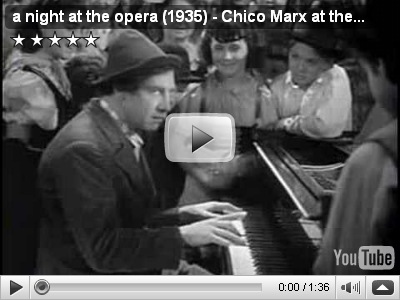
And here, in A Night At The Opera, Chico entertains a group of children with All I Do Is Dream Of You.


It takes real talent to make it look this effortless.


And here we have an intricate piano duet with Harpo, of Mama Yo Quiero from The Big Store.


Arthur Adolph "Harpo" Marx (November 23, 1888 – September 28, 1964) was the second eldest of the Marx Brothers and while he never spoke on stage, could hardly be described as a `silent partner’.


He always worked in pantomime wearing a red `fright wig, and by playing (rarely) the piano and more often the harp, after which he was named.


harpo

Make no mistake, Harpo was a killer harpist, able to play sweet or hot, as the situation demanded.  His `jazz’ renditions of classic tunes are unforgettable.


Unlike his brothers, who were unlucky in love, Harpo married Susan Fleming in 1936 and their marriage was lifelong.  Some people believed that Harpo really was mute, but in truth this was simply part of the `act’. 


Here Harpo plays the Second Hungarian Rhapsody . . .sweetly at first, then he swings it.  This bit of genius is from A Night in Casablanca.


Harpo performs Everyone Says I Love you from Horsefeathers.


And here Harpo creates musical mayhem during a recital.  This From Monkey Business.


The Marx Brothers were more than just funny, they were multi-talented.   Something that isn’t nearly as common today as it was during the heyday of Hollywood.

Back then actors could dance, dancers could sing, and comedians could do drama, or play musical instruments. 

A legacy from Vaudeville where being a jack of all entertainment trades was the best way to keep working.

Sunday, June 21, 2009

Warner Brothers Breakdowns Of The Late 1940s


In the 1960’s, Kermit Schafer (24 March 1923 - 8 March 1979) released several record albums of bloopers from radio broadcasts.  One of the earliest was radio announcer Harry Von Zell’s mispronunciation of President Herbert Hoover’s name as "Hoobert Heever" on the air. 


I had the Schaefer albums, and enjoyed them greatly, but didn’t realize at the time that many of these audio clips were `recreations’.


Back in the 1930’s and 1940’s, most shows were aired live, and many were never recorded.  Schaefer hired actors, who recreated the bloopers, but never disclosed that fact on the album.  


Flawed or not, Schaefer did help create the blooper craze, and led the way for popular TV shows like TV's Bloopers & Practical Jokes, hosted by Dick Clark.


Long before Schaefer, however, movie studios and production companies kept `blooper reels’, and usually only showed them during private parties.   The language of some of these gaffs was a bit `adult’, for greater distribution.


In the past, I’ve highlighted the Warner's blooper reels of the 1930s and the early 1940s.   


We’ve a couple more to round out the collection (hopefully more will turn up);  The Warner Brothers Breakdowns of the Late 1940s.